Tuesday, August 4, 2020

CLEANSE THE HEART

 Reflection for Tuesday of the 18th Week in Ordinary Time, Year A
(Jer 30: 1-2, 12-15, 18-22; Mt 15:1-2, 10-14)

Prophet Jeremiah began to announce a message of hope. “Thus says the Lord: Behold, I will restore the fortunes of the tent of Jacob, and have compassion on his dwellings; the city shall be rebuilt upon its mound, and the palace shall stand where it used to be.” All the idols they ran to could not help; only God would heal this wound. No more foreign rulers, but their ruler shall come forth from their midst. “And you shall be my people, and I will be your God.”

It was dramatic in the Gospel as the Pharisees and Scribes from Jerusalem came to Jesus. These were law-conscious first class citizens. They complained about the disciples not washing hands before eating. Jesus turned to the people, called their attention and said, “Hear and understand: not what goes into the mouth defiles a man, but what comes out of the mouth, this defiles a man.” This answer was a blow on their pride and sense of relevance! They took offence at Jesus.

What comes out of the mouth, comes from the soul, and expresses the state of the heart. And since God looks at the heart—the centre of thought and emotions—it is what makes one to be in good standing with God or not. Thus, washing hands as a form of cleansing to avoid defiling the person before God is misplaced. It is the heart that ought to be cleansed, then, the words that comes forth would be clean. In other words, the defilement that comes from the mouth ought to be uprooted from the heart and mind. How can this be possible?

“I, the Lord, search the heart, test the motives, to give each person what his conduct and his actions deserve” (Jer 17:10). The heart is a ‘secret place’ and elusive. If the word that comes from man can defile him, taking in the word that comes from God will heal him. And if the word of God makes its home in our hearts (Eph 3:17), then, our mouths will speak of the righteousness of God, joy and peace. That was why the Pharisees and Scribes who closed their eyes with pride and jealousy against the words of Jesus, vomited anger and persecution. By meditating on the word of God each day, our hearts shall be like trees planted by the waterside that is evergreen, producing good fruit in season and out of season (Ps 1:2-3; Jer 17:8). Learn this spiritual exercise, and Jesus will make His home in you. And no defilement shall take root in you.

As you continue to join in our meditations on the Mass readings, May God sanctify + you that your every labour may bear fruit to the glory of God, Through Christ Our Lord. Amen!


Fr Jude Chinwenwa Nwachukwu, C.Ss.R
Saints Peter & Paul Catholic Church,
Tedi-Muwo, Lagos.
Tuesday August 4th, 2020.
Memorial of St. John Mary Vianny
www.nwachinwe.blogspot.com


Monday, August 3, 2020

“LORD, SAVE ME”

Reflection for Monday of the 18th Week in Ordinary Time, Year A
(Jer 28:1-17; Mt 14:22-36)

It was dramatic for Prophet Jeremiah as he battled with the fake prophet, Hananiah. Against Jeremiah’s warnings, Hananiah told the people what they wanted to hear: that God had broken the yoke of the King of Babylon, and all the exiles and vessels would be restored. He was very outspoken and aggressive in his approach, tearing the symbolic wooden yoke Jeremiah wore on his neck.  Often times, lying lips are the loudest and overpowering but they do not last (Pr 12:19). They come like a raging storm to sink whoever is not already standing firm on truth. Hananiah’s message was ‘convenient’, soothing the people’s lifestyle.

 God will destroy every lying tongue (Ps 12:3). The Lord announced severe punishment for Hananiah. “Go, tell Hananiah...You have broken wooden bars, but I will make in their place bars of iron.” For deceiving the people, this fake prophet was cut off from the face of the earth. Sugar-coated words that appeal to our human convenience usually attract easy followers. When a child of God begins to follow the same ideologies with unrighteous people, he should be careful because falsehood is not far from him. Truth is of God; when we abide in truth, we enjoy God’s presence and long for Him. Be careful of persons, lifestyles, actions, transactions, etc that pull you away from God; they make you ‘foreign’ to God and wound your prayer life. If it happens, know that lies are knocking.

 As we said earlier, most times we are deceived because we had already lied to ourselves. Through faith in Jesus Christ, we are walking on the ‘turbulent waters of this world.’ We love in the midst of hate; we still trust though living among deceivers. We live and move in an insecure society; we make huge investments in an economically barren society. The storm is raging! Fake prophets, loud and domineering, are fuelling our stagnant and staggering faith-life with ‘prophecies’ that only make us shout, AMEN! But the messages do not challenge us to repent and draw closer to God, while some other 'prophecies' have no reference to our well-being or our salvation.

 So, we constantly cry out in the words of Peter, “Lord, save me.” This prayer must be the disposition of our heart, a ‘mantra’ with which the heart breads. In this way, Jesus, who is the Truth, will sustain us and save us from sinking into the ocean of lies. As you go about your activities this Month, may Jesus hold you firm on the truth, and save you from deceivers. Amen.


Fr Jude Chinwenwa Nwachukwu, C.Ss.R
Saints Peter & Paul Catholic Church,
Tedei-Muwo, Lagos.
Monday August 3rd, 2020.
www.nwachinwe.blogspot.com


Sunday, August 2, 2020

THE SILENT PLACE OF SATISFACTION

Reflection for 18th Sunday in Ordinary Time, Year A
(Is 55:1-3; Rm 8:35-39; Mt 14:13-21)

1.0.  THE LONELY PLACE

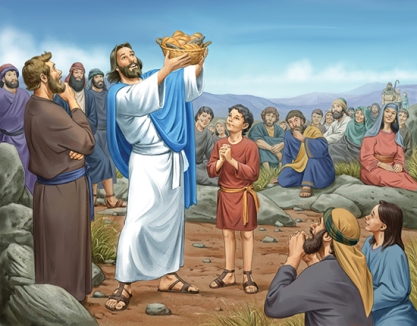
“When Jesus heard of the death of John the Baptist, He withdrew from there in a boat to a lonely place apart.” Imagine the debt of sorrow and distress Jesus had to bear in the face of human wickedness! And relate it to how many people today are frustrated, heartbroken, and other forms of emotional distress. Jesus withdrew from the noise—from the people and His ‘ordinary activity’ of the day—and went to a quiet place to stay alone. Within that ‘silent place’, He would drink the cup of sorrow to the full and conquer it. He would step out of it, re-energized and satisfied.

Think about the ‘wine and milk of satisfaction’ that Isaiah offered in the first reading. Such satisfaction can be likened to the freshness of heart we get when we step in with Jesus into ‘the place of silence.’ Isaiah said, “Incline your ear, and come to me; hear, that your soul may live; and I will make with you and everlasting covenant...” This inner peace is given freely, to everyone who thirsts, at no cost! Jesus has sanctified the ‘place of silence’ as necessary for healing hurts and finding inner satisfaction.

2.0.  THE CROWDS FOLLOWED HIM

Suddenly, Jesus’ quiet moment was disrupted; they crowds found Him out. This ‘demanding crowds’ can be compared to ‘distractions’ in prayer. Many people run away from meditation because they just cannot concentrate. Once they step into the room of silence ‘Crowds of thoughts’ would step in and dislodge their concentration. These ‘attention seekers’ would want to sap the energy we got from the ‘wine and milk’ we drank in the room of meditative silence. So, from His lonely place, Jesus stepped out with deep compassion for the crowds and attended to them. What ordinarily came as a distraction to His quiet time became ‘an action of God’ among the people. This ‘action of God’, which they felt in the authority of His teaching and the healing of the sick, would grow into providing satisfaction to the crowds.

3.0.   “AND THEY ALL ATE AND WERE SATISFIED”

The disciples had three complains: 1. It was evening; darkness would soon descend, so the people should be dismissed as soon as possible. 2. It was a lonely place; they had nowhere to get help. 3. The crowds were too many; the number of ‘mouths to feed’ was more than their resources, which were five loaves and two fish! Note that each of these ‘obstacles’ was enough for Jesus to give up. But the energy of His deep compassion, which is rooted in the silence of the heart, was stronger than the weakness the obstacles represent.

Readings & Reflections with Cardinal Tagle's Video: 18th Sunday in ...

Therefore, “And taking the five loaves and the two fish He looked up to heaven, and blessed and broke and gave the loaves to the disciples, and the disciples gave them to the crowds.” The first response a contemplative heart gives to the weakness of others is ‘compassion.’ Love will always find a way out. The compassionate response of Jesus transformed the bread and fish into a 'concrete action of God’ as the crowds ate to their satisfaction. The beauty of this action illumined the darkening evening, and turned the ‘lonely place’ into a garden of refreshment. But this sublime and awesome act would lead any honest heart that tasted the meal to contemplate Jesus. Here, the heart continues to ‘feed’ on Jesus in silence.

4.0.  THE HEART OF SILENCE

A heart that ‘feeds’ on Jesus, in silent meditation, cannot be lonely; it is warm, peaceful and compassionate. It is a heart that has fallen in love with Jesus. It is a Eucharistic heart that clings to Jesus like the Beloved Disciple at the Last Super. Nothing can separate such a one from Jesus. Whether he is busy or resting, in tribulation, distress, persecution or in need, he is “more than a conqueror through Him who loved us.” This binding love we have in Christ Jesus is stronger than any principalities or human weakness. Through meditation, our heart becomes a ‘lonely place’, where we enter (with coordinated attention on the word of God) to encounter Jesus in silence.

As you have joined in THE SOUND OF SILENCE meditation this Sunday, may God satisfy the yearnings of your heart and quench your thirsts. May He renew His love in you so that you are more than a conqueror in every challenges you may face. May Almighty God bless + you, in the Name of the Father and of the Son and of the Holy Spirit. Amen.


Fr Jude Chinwenwa Nwachukwu, C.Ss.R
Saints Peter & Paul Catholic Church,
Tedi-Muwo, Lagos.
Sunday August 2nd, 2020.
www.nwachinwe.blogspot.com 


Friday, July 31, 2020

WHEN TRUTH HURTS

 Reflection for Friday of the 17th Week in Ordinary Time, Year A

(Jer 26:1-9; Mt 13:54-58)

It is always difficult to do the right things. We easily follow the wrong crowd or spend much time on things that do not really matter. Have you noticed that sometimes the real people that matter in our lives receive less attention! We all want good things and we hate liars, but why does truth hurt? It is difficult to follow ‘crowd life’ or ‘trending ideas’ without abiding in falsehood. In the readings of today, both Jeremiah and Jesus were rejected by their people respectively.

The Lord sent Jeremiah to the Temple on the Sabbath to address the people as they gathered to worship. He warned them of the looming danger if they refused to repent. “Thus says the Lord: if you will not listen to me, to walk in my law...and to heed the words of my servants the prophets whom I send to you urgently...then I will make this house like Shiloh...” Hearing this, instead of repenting of their evil ways, they got angry at Jeremiah. His words became an arrow that pierced their hearts. The priests, the fake prophets, and all the people gathered around Jeremiah and held him, saying, “You shall die!”

In the same vein, Jesus came to His home town and taught in the synagogue. His message touched them. They were surprised, and said, “Where did this man get this wisdom and these mighty works? Is not this the Carpenter’s son? Is not his mother called Mary?” They took offense at Him, and refused to accept Him. But Jesus answered that a prophet is not without honour except in his own country and in his own house. And he could not perform any miracles there because of their unbelief.

Truth hurts when we have settled for falsehood and accepted it as ‘truth.’ Then, the presence of truth begins to appear like falsehood. In the case of Jeremiah, the people were engrossed in the ‘peace’ they enjoyed while disregarding God’s law. They took pride in the beautiful temple, while their personal lives were abomination unto the Lord. But Jesus was rejected because His people held tight to their pre-conceived knowledge of Him, and they refused to be open to a new discovery about Him. ‘Truth’ displaces our ‘centre of pride’, uprooting it from our self-pleasure or ‘personal convenience’ to the righteousness of Jesus Christ, who is Truth Himself (Jn 14:6). Secondly, truth is ‘ever new.’ It brings newness to the heart. Truth hurts in a heart that is hardened; a heart that is not open to the fresh outpouring of the Holy Spirit.

Imagine the danger the Israelites faced by rejecting Jeremiah, and the divine blessings the Jews missed by not accepting Jesus. These are the cost of falsehood. Jesus has come to make His ‘home’ in our hearts. He comes, loaded with blessings. Let us not reject Him by holding to our old ideas or be blindfolded by self-centred lives. The word of God sets us apart from the crowd. We pray today that God will open our ears to hear the truth, and the courage to accept it. May He remove all falsehood from our ways. Amen.

 Fr Jude Chinwenwa Nwachukwu, C.Ss.R

Saints Peter & Paul Catholic Church,

Tedi-Muwo, Lagos.

Friday July 31st, 2020.

Memorial of St Ignatius of Loyola.


Thursday, July 30, 2020

THE POTTER'S CLAY


Reflection for Thursday of the 17th Week in Ordinary Time, Year A
(Jer 18: 1-6; Mt 13:47-53)
The Lord sent Jeremiah to the potter’s house for an important lesson. He saw the potter working at his wheel. “And the vessel he was making of clay was spoiled in the potter’s hand, and he reworked it into another vessel, as it seemed good to the potter to do.” The potter had in mind the design he wanted, if the clay did not come out as he wanted, he reworked it. Then the Lord spoke to Jeremiah concerning Israel, saying, “Can I not do with you as this potter has done? Behold, like the clay in the potter’s hand, so are you in my hand, O house of Israel.”

So, we are like clay in the hands of God. He created us in His own image and likeness, but the ‘clay’ spoiled due to sin and selfishness. Now, He decided to rework us into another vessel, which is Jesus Christ. Yes, He will continue to remould us into the image of His Son until we fit perfectly into the Original design He had in mind (Rm 8:29). Imagine the patience, the dexterity and love with which the skilled Potter is handling our fragile earthen life, carefully transforming us each day into ‘another Christ.’ So, we carry in ourselves the imprint of the life of Jesus (2Cor 4:10-11). As long as we are alive, God continues to remould us; we must dispose ourselves in His arms, and cooperate with His grace at all times.

But time will not be with us forever. The parable of the net that was cast into the sea, which gathered all sorts of things both good and bad, tells us that there will be time to sort out the good from the bad. At that time, there will not be opportunity to remould our lives. Evil shall be destroyed as wastes are burned in a fire.

The message of Jeremiah is encouraging. May be we have failed several times to imitate Jesus. Sometimes it appears we are stagnant in our spiritual journey. Changing times and situations, such as health failure, financial crisis, death, etc can becloud our minds and distract us from our commitment to live like Jesus. God says through the prophet that He is still working on this fragile Clay. If God is still working, we should continue to cooperate with Him. Do not give up on yourself; trust in His grace. At the end of the day, Christ Jesus will be all in all (cf. 1 Cor 15:28).

Fr Jude Chinwenwa Nwachukwu, C.Ss.R
Saints Peter & Paul Catholic Church,
Tedi-Muwo, Lagos.
Thursday July 30th, 2020.

Wednesday, July 29, 2020

THE ONE THING NEEDFUL


St Martha, Disciple of the Lord
Lenten Blog Day 37 With a little help from my friends… – My ...
Matter of Martha
The name ‘Martha’ means ‘Lady’ or ‘Mistress of the house.’ St Martha was a sister to Mary and Lazarus. They were referred to as ‘friends of Jesus’ (Jn 11:5). It is not clear who is the eldest among the three, but from her ‘disposition’ Martha seems to be the eldest. She  appears to be the ‘spokesperson’ of the family. She was the chief host, the one who welcomed Jesus into their house (Lk 10:38; Jn 11:20). There is every indication that Martha was outspoken and a lively lady, for she ran out to meet Jesus, and did not hesitate to express her displeasure that Jesus did not respond to the ‘sick call’ promptly. “Lord, if you had been here, my brother would not have died” (Jn 11:21). She seems to be very generous and caring as she served Jesus and the guests (Jn 12:2).

Martha loved her family; she did all she could to save her brother’s life. After she received Jesus, she went and called her sister to come and meet Jesus, saying to her in a low voice, “The Master is here and wants to see you” (Jn 11:28). At the tomb of Lazarus, when Jesus asked for the stone to be rolled away, Martha thought He wanted to go in to see the dead body, so she tried to discourage Him, saying, “Lord, by now he will smell; this is the fourth day since he died” (Jn 11:39).

Friend of Jesus
Martha was a woman of faith. She believed in Jesus. That was why she sent for Him to come and cure her brother. Even when all seemed to be lost, she said to Jesus, “But even now I know that God will grant whatever you ask of Him” (Jn 11:22). And she professed her faith in the resurrection (Jn 11:27). Now we can understand why she welcomed Jesus with such warmth and generosity.

It was for her care for Jesus that she got herself “distracted with much serving” (Lk 10:40). She worked herself out trying to entertain Jesus and those with Him. She was not happy with her sister who sat down listening to Jesus instead of helping her serve. But being a friend of Jesus, and expecting Him to have noticed her ‘frustration’, Martha offloaded her worries unto the Lord. “Lord, do you not care that my sister is leaving me to do the serving all by myself? Please tell her to help me” (Lk 10:40). Think about this: ordinarily, she would have picked offense directly with her sister, but she wanted the Lord to ‘settle her case.’

The One Thing Needful
“Martha, Martha, He said, you worry and fret about so many things, and yet few are needed, indeed only one...” Imagine the love and respect with which Jesus addressed her. It shows that even before she complained, the Lord had seen and received her ‘servings’ but she had to be directed to the ‘one thing necessary.’ Being friends with Jesus—to contemplate Jesus—is the one thing necessary. Finding fulfilment, the fulfilment that only Jesus can give, is the reason we work. So, work expresses contemplative beauty. And contemplation itself is the most important task as Jesus showed that Mary was not idling away, but engaged in the most sublime labour.

As Jesus comes into our hearts today, how do we welcome Him? Do we push him aside and got engrossed in our tasks? We should engage Him in the silence of our hearts, ‘sitting at His feet in meditative attention’, which is the one thing needful. Then every other work we engage in will not weigh us out. Martha is the patron saint of cooks, housewives, waiters and servants. St Martha, pray for us. Amen.

Fr Jude Chinwenwa Nwachukwu, C.Ss.R
Saints Peter & Paul Catholic Church,
Tedi-Muwo, Lagos.
Wednesday July 29th, 2020.
Memorial of St Martha, Disciple of the Lord
www.nwachinwe.blogspot.com


Tuesday, July 28, 2020

THE ATTENTIVE EAR


Reflection for Tuesday of the 17th Week in Ordinary Time, Year A
(Jer 14:17-22; Mt 13:36-43)
At the end of the parable of the weed planted among the good seed, Jesus said, “He who has ears, let him hear.” This phrase indicates the seriousness of the message, and the need to be attentive and for prompt response to it. Prophet Ezekiel used the phrase to show that the word of God was being announced to a rebellious and stubborn people (Ezk 3:27). Hearing that statement, we come to understand how the word of God respects our freedom of choice, and sets us free. At the same time, it appeals to us to choose the message and act on it. “He who has ears, let him hear” presumes that we have ears, and should be wise to listen to do what the word says. And we are responsible for the consequences that would come upon us if we turn deaf ears to the word of God.

At the end of the parable, the unproductive and useless weeds, which represent all causes of sin and evildoers, are gathered by Angels and thrown into the furnace of fire, where there will be great suffering. “Then the righteous will shine like the sun in the Kingdom of their Father.” So, he who has ears will surely choose to live a righteous life. But knowing the right thing to do does not mean we will do it automatically. We do not easily listen to what God says, but we want God to listen to what we say.

The Prophet Jeremiah in the first reading addresses God as the only true God who hears His Children. So, he pleads to God on behalf of the people, telling Him all the sufferings and terrors they have been through. “If I go out into the field, behold, those slain by the sword! And if I enter the city, behold, the diseases of famine...” He asked God not to abandon Zion as they acknowledge their wickedness, the iniquities of their fathers, and their sins against God. Since God hears and answers prayers, Jeremiah affirms that their only hope is in God.

Therefore, to have an attentive ear to God who listens to us, we must incline our hearts to righteousness. Sin blocks our spiritual ears, such that we live like those who have ears but do not hear. And none of us can bear the consequences thereof. To develop an attentive ear to God, we must begin to listen to the silent voices within our hearts that speaks of peace, love, and self-denial. Every prompting of the heart that inclines us to selfishness and pride must be rejected. If we are attentive to God, surely, we will be attentive to those around us. We have ears; let us not harden our hearts, but listen to the word of God today (Heb 3:15).

Fr Jude Chinwenwa Nwachukwu, C.Ss.R
Saints Peter & Paul Catholic Church,
Tedi-Muwo, Lagos.
Tuesday July 28th, 2020.
www.nwachinwe.blogspot.com