Tuesday, December 17, 2019

ADVENT WITH MARY

A journey into Advent through the eyes of Mary
By
Fr Jude C. Nwachukwu, C.Ss.R
Image result for Advent with Mary
1.0.Introduction: Mary, the Embodiment of Advent
The season of Advent is the period we celebrate in hope the second coming our Lord Jesus. This is done through commemoration or a solemn liturgical ‘re-living’ of the first advent, in which the people of Israel waited for the birth of the Messiah. This expectant period, stretching from the fall of man to the birth of Jesus at Bethlehem, was marked with series of events. This generational expectation of redemption can be summarized and viewed in a deeper contemplative way through the Blessed Virgin Mary’s nine months pregnancy period as she looked forward to her own delivery. She became, therefore, the culminating point of all who looked forward to the deliverance of God’s people (cf. Lk 2:38). Further, in this Advent liturgy, we celebrate in thanksgiving Jesus’ coming to us today in grace. He is present at every moment of our lives. And Mary, full of grace, intercedes for us that we might have an encounter of grace today.
Mary is the Mother of our Advent—our expectation of the Messiah is given a living hope through her. Our longing for Jesus at all times and in every situation, radiates with joy when in silence and faith we connect it to the Virgin Mother, whose expectation for Jesus ranked highest for all generations.
LET US PRAY
v  Pause:........(Brief Silence. End the Silence with a deep breath)
v  State your intentions...
v  Our Father
v  Hail Mary x3
v  Glory be to the Father

2.0.   THE WOMAN
“I shall put enmity between you and the woman, and between your offspring and hers” (Gen 3:15). This passage is popularly recognized as the first pronouncement of good news after fall. Once Adam and Eve disobeyed and fell from grace, they did not see all the glamour that Satan promised them, instead they were confronted by guilt, shame, loss of dignity and self-esteem. Definitely, the consequences of the fall awaited them. They longed for that which they had lost, but no more! In attempt to ‘save’ themselves, Adam and Eve sewed fig-leaves and hid under the trees...(Gen 3:7-8). But the trees could not hide the shame of their ungraced nature! God called out to them...
Image result for the offspring of the woman will crush the head of serpent
The Lord God announced the defeat of Satan by the Offspring of the Woman. I guess Adam from his hiding place, hearing this good news, would probably long for that day when the enemy’s tricks would be exposed. From that time the development of the history of salvation looked forward to this Offspring that will redeem humanity. “But when the completion of time came, God sent His Son, born of a woman...” (Gal 4:4-5). Jesus Himself confirmed this title, ‘woman’ for the Virgin Mary at the wedding in Cana and at Calvary (Jn 2:4; 19:26).
“Reminiscences of Gen 3:15 are echoed in Revelation 12:9 which identifies the serpent with the Devil, Satan”[1] The defeat of Satan by the Offspring of the Woman announced since the foundation of the world was fulfilled in Rev 12: 10-12, “Salvation and power and empire for ever have been won by our God...now that the accuser...has been brought down. They conquered him by the blood of the Lamb...” Since the Woman escaped the clinch of Satan, and her Offspring crushed his head by the Cross, “Then the dragon was enraged with the woman and went away to make war on the rest of her children, who obey God’s commandments and have in themselves the witness of Jesus” (Rev 12:17).
Therefore, the Woman, the Blessed Virgin Mary, is the universal mother. Her birth pangs equally embodies the yearnings of the Children of God to have their prayers answered and be saved (cf. Jn 16: 21-22; Rm 8:19). All who are born anew in Spirit and in truth, who hear the word of God and keep are given power to become the Children of God—i.e other offspring of the Woman, who are equally destined to crush the head of Satan by the Blood of the Lamb. So we make our advent with Mary as we look forward in hope to share in the saving joy of Christmas.
LET US PRAY
v  Pause:........(Brief Silence. End the Silence with a deep breath)
v  State your intentions...
v  Our Father
v  Hail Mary x3
v  Glory be to the Father

3.0.  The Virgin Mother
“The Lord will give you a sign in any case: it is this, the virgin is with child and will give birth to a Son whom she will call Immanuel” (Is 7:14). From the beginning, the message of Salvation for God’s people included within it the mother of the Saviour. As the time drew near, the Prophets began to re-assure the people of the fulfilment of God’s promise. There were several prophetic signs given to them to re-enkindle their hope. The sign of the Virgin Mother was the most ‘immediate sign’ to clear all doubt that the Saviour is at hand. Thus, the messianic prophecy included within it, the prophecy about the Virgin Mary. In other words, the Virgin Mary formed the most intimate among the ‘cloud of witnesses’ that would announce the dawn of Salvation.
The unique character of the Mother of Jesus as ‘Virgin’ is so important that it featured in the Advent prophecy! Matthew 1:23 cites the verse of Isaiah 7:14 as a proof that the prophecy about the messiah is being fulfilled. That Angel Gabriel visited a virgin whose name was Mary places his message in line with the prophetic tradition about the coming messiah (Lk 1:26-27). The title ‘Virgin’ sets Mary apart as ‘blessed among women’ (Lk 1:42) and preserved totally for the mission. Her virginity concretely expressed her purity, humility, faith and undiluted love for God. Above all, it is a sign that the child to be born will be great and will be called Son of the Most High (Lk 1:32). He will be “born not from human stock or human desire or human will but from God himself” (Jn 1:13). As the Angel revealed to Joseph, “She has conceived what is in her by the Holy Spirit” (Mt 1:20). And the Child to be born “Is the one who is to save his people from their sins” (Mt 1:21).
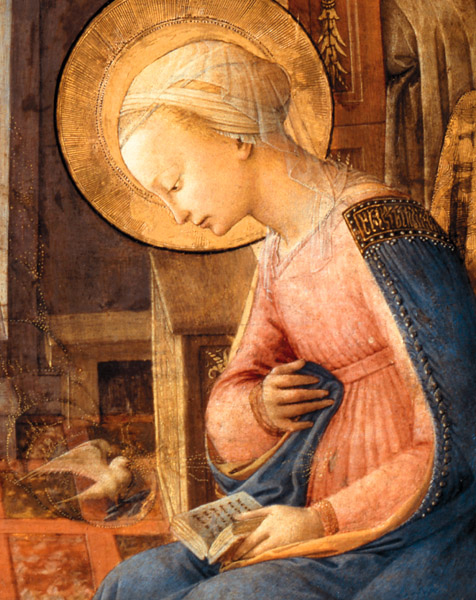
Image result for Virgin and mother
Therefore, as we await our Saviour this Advent, we look out for the Virgin who is with Child! This is the ultimate sign that our salvation is nearer that we ever thought (cf. Rm 13:11). So we contemplate Advent with the Blessed Virgin Mary that our hearts be flooded with grace, and our petitions be answered.
LET US PRAY
v  Pause:........(Brief Silence. End the Silence with a deep breath)
v  State your intentions...
v  Our Father
v  Hail Mary x3
v  Glory be to the Father
4.0. The Daughter of Zion
    “Shout for joy, daughter of Zion, Israel, shout aloud! Rejoice, exult with all your heart, daughter of Jerusalem!” (Zeph 3:14). In announcing the coming Messiah, the prophets addressed Jerusalem as ‘daughter’ and proclaimed ‘joy’ to her. Jerusalem is asked to rejoice because of God’s dwelling within the city (cf. Joel 2:21-23; Zeph 3:14-15; Zc 9:9)[2]. The formula of greeting addressed to ‘daughter of Zion’ was used by Angel Gabriel when he visited Mary. “Rejoice, full of grace. The Lord is with you” (Lk 1:28). “What in the prophecy is said to daughter of Zion is now directed to Mary: She is identified with daughter Zion, she is daughter Zion in person.”[3] She becomes a total embodiment of the expectant people, the remnant of Israel, poor and humble, who kept faith and waited for the fulfilment of God’s promise.
Image result for Virgin and mother“After a long period of waiting the times are fulfilled in her, the exalted daughter of Zion and the new plan of salvation is established...”[4] So Mary stands before humanity as the ‘Universal Mother’, the ultimate personification of God’s chosen people. In her, Zion enters into personal relationship with her Saviour. Also, as daughter of Zion, Mary stands before God as the humble handmaid, faithful and recollected; surrendering herself to be the mother of her Lord! So Mary’s life is such that she is a place for God, the most pure Temple of the Most High, a sort of ‘holy city, in person.
The Blessed Virgin Mary did not live a self-enclosed life; she lived for God and for others. The joy of Mary—the joy of Christmas—comes to us as grace, and must be open for others to share in it. In Mary the daughter of Zion, openness to this joy is personal and communal. Our advent season is flooded with joy—the joy that the Lord Jesus has come to save us—the joy of the Daughter of Zion.
LET US PRAY
v  Pause:........(Brief Silence. End the Silence with a deep breath)
v  State your intentions...
v  Our Father
v  Hail Mary x3
v  Glory be to the Father

Fr Jude Chinwenwa Nwachukwu, C.Ss.R
Saints Peter & Paul Catholic Church,
Tedi-Muwo, Lagos.
Friday, December 13, 2019
Memorial of St Lucy, Virgin & Martyr.


[1] Bertrand Buby, SM, Mary of Galilee, New York: Alpha House, 1995, p.32.
[2] Cf. Bertrand Buby, SM, Mary of Galilee, New York: Alpha House, 1995, p.18.
[3] Joseph Cardinal Ratzinger in Mary: The Church at the Source, Transl. Adrian Walker, San Francisco: Ignatius Press, 1997, p.65.
[4] Vatican II, Lumen Gentium 55.

Sunday, December 15, 2019

THE MESSIANIC TIDINGS


Reflection for the 3rd Sunday of Advent Year A
(Gaudete Sunday)
(Is 35:1-6, 10. James 5:7-10; Mt 11:2-11)
THE DRY LAND SHALL BE GLAD
Image result for Isaiah prophet“The wilderness and the dry land shall be glad, the desert shall rejoice and blossom...and rejoice with joy and singing.” The Prophet Isaiah used this analogy to describe the messianic blessings to come. Dry land presents different categories of unfruitfulness, hopeless, toughness and pain. “They shall see the glory of the Lord, the majesty of our God.” He comes with recompense! Also, the coming of the Lord shall bring healing and freedom from bondage. Finally, the Prophet announced that the coming of the Lord shall bring joy. “The Lord shall return, and come to Zion with singing; everlasting joy shall be upon their heads; they shall obtain joy and gladness...”

PATIENT-ENDURANCE
The voice of the prophet is still alive today. Our Advent—the expectation of a Christmas encounter—is loaded with such blessings that our longing for the Messiah is ever warm and alive. Thus every experience of ‘dry land’ quickens our advent steps as we match to behold Jesus. So the Second reading advises us to match with patience until the coming of the Lord. St James uses the analogy of a farmer who patiently looks forward to harvesting his crops. Thus the silent meditation of our hearts should be focused on the coming of the Lord. If we are wrapped in this patient expectation of the hour of grace—dawn of salvation—we will not grumble nor judge one another, for “Behold, the Judge is standing at the doors.” With patient-endurance we shall step on our every ‘dry land’, filled with hope and joy that God is with us!
Image result for john the baptist in prison 
THE MESSIANIC BLESSINGS
But this prophet, John the Baptist, is in prison! The precursor, who introduced the Messiah, has been reduced by human wickedness. He who lived in the desert, ate locust and honey, but had people around him, is now locked up in the city prison with only darkness as his neighbour. John the Baptist who was the ‘voice’ for the Messiah is now wondering if his message was true... “Are you he who was to come, or shall we look for another?” Jesus pointed out the messengers that the messianic blessings promised by Isaiah are now being fulfilled: “The blind receive their sight and the lame walk...” So dry lands are blossoming again! This can only happen with the presence of the Saviour.

As the messengers left, “Jesus began to speak to the crowds concerning John.” So he who lost his voice because of Christ has found his voice anew in Christ Jesus. While John the Baptist was in prison, Jesus stands out in the light for him, and defends his name and dignity. Though Herod tried to silence John, his voice continues to echo in Christ Jesus; though they took away his freedom in the dark prison, he remains free and shining in Light in Christ Jesus. John was treated with contempt, and death awaited him, but Jesus proclaimed him the ‘greatest among those born of women’, and announced his eternal place in the Kingdom of Heaven.

When we look at John the Baptist from the eyes of Herod, we see a man condemned, with no beauty or hope. It is a life in dry land, with neither refreshment nor fruitfulness. But when we see John from perspective of Jesus Christ, we understand deeper the prophecy of Isaiah about how the coming of the Messiah will make dry land to blossom and rejoice. We see a beauty, healing, greatness, freedom and life that no Herod can take away! This is the glory that Christmas brings—the messianic blessings—which we must look forward to with patient-endurance. Let us in silence focus meditate on these great tidings.

Fr Jude Chinwenwa Nwachukwu,C.Ss.R
Ss Peter & Paul Catholic Church,
Tedi-Muwo, Lagos.
Sunday December 15, 2019.


Sunday, December 1, 2019

His Coming; Our Waiting!

Reflection for the First Sunday of Advent Year A
(Is 2:1-5, Rm 13:11-14, Mt 24:37-44)
Image result for advent
The “coming” of our Lord is clearly announced in the readings of this Sunday. This captures the mood of the whole season of Advent and properly defines it. The Prophet Isaiah announced the coming of the ‘long expected Saviour,’ who will restore peace among the nations. St Paul in the second reading relates to the ‘now’ of His coming. “Salvation is nearer to us now…” There is a dimension of Jesus’ advent that is on-going. This can only be experienced when we put off the works of darkness, and “put on the Lord Jesus Christ, and make no provision for the flesh.” The Gospel introduces us to the future advent. The characteristic of this second coming is that it will be at a time no one knows. “Watch therefore, for you do not know on what day your Lord is coming.”

His coming, therefore, necessitates our waiting! Jesus’ advent, both now and in the future, is marked with power and glory. He is coming to meet those who are waiting. But those who are waiting are those who already have received Him! Thus, in His coming, the ‘now’ and the ‘future’ are mingled. Hence, though we do not know His Hour, we have every ‘hour’ if we receive Him ‘now.’ That is why only those who refused to cast off works of darkness would be taken by surprise, for even before His coming, they had already missed Him. Therefore, his coming, both now and at the end, gives life and energy to our waiting.

His coming; our waiting! Obviously, waiting for the Lord is not passive. It draws vision by contemplating His coming, challenges us to work on our moral and spiritual life so as to receive the Lord now, and meet Him at the end. The power and glory of His coming shines out in our waiting for the Lord. Thus our hearts are warm and silent as we move forward to embrace the Lord anew this advent.

Advent celebrates with a penitential joy our waiting for the glorious coming of our Lord Jesus Christ. The victory of grace today, and His final triumph over every evil in the world, is echoed in our celebration this season. The liturgical gestures and symbols in this season of advent contemplate our waiting and His coming.

Fr Jude Chinwenwa Nwachukwu, C.Ss.R
Saints Peter & Paul Catholic Church,
Tedi-Muwo, Lagos.
Sunday, December 1st, 2019.

Sunday, October 27, 2019

HUMILITY AND PRIDE AT PRAYER

REFLECTION FOR 30TH SUNDAY IN ORDINARY TIME
 (Sirach  35:12-14, 16-18; 2Tim 4:6-8,16-18; Lk 18:19-14)
1.0. Humility and Pride
As we are drawing close to the end of the liturgical year, the readings of today focus on the theme of humility, especially in relation to prayer. The book of Sirach explains how God pays attention to the lowly, i.e. the poor, the orphans, the widow, etc. “He will not ignore the supplication of the fatherless, nor the widow when she pours out her story.” Also, those who are poor in spirit—the humble of heart—receive similar attention. “The prayer of the humble pierces the clouds.” Humility attracts favours from the Lord. “A humble contrite heart you will not spurn o Lord” (Ps 51:17).

The temptation to be proud caused the fall of man, and is the reason for every fall from grace. Prayer melts pride, but pride makes prayer difficult and empties it of favour. By nature, the gift of free will places man at the cross roads of pride and humility. It is a subtle step, and an easy slip that diverts one’s steps to either direction. The choice for God and the exaltation of his glory is always a quick step to humility.

Jesus tells us the story of the Pharisee and the tax collector to expose the attitude that smells of pride and the way of the humble. Interestingly, pride and humility came to the house of God! That is why it can be difficult sometimes to differentiate.  It is God alone who knows the secret of the heart. The Lord alone is the righteous judge, as St Paul wrote to Timothy. However difficult it might be, the parable of today indicates that prayer can expose the heart. The tone and manner of one’s prayer can reveal if he is humble or proud.
Image result for the pharisee and the tax collector
2.0. SPACE AND SILENCE
In the parable, the Pharisee stood at a close distance to the sanctuary! The image of space in the story is worth noting. Here the audacity of the Pharisee is seen in his desire to ‘occupy space,’ and fill in gap, proving that him is worthy of such closeness. This is how pride tries to fill up every space in the heart such that there is no space for God. Thus, he is full of words, no space; no silence! From exonerating himself to condemnation of others, and back to exaltation of his deeds, the proud man never lacks words, high sounding words that have not roots in silence. While he continued to clatter his mouth, God gazed at the depth of his heart...

The humble man kept his distance. He found himself not worthy, and created a space, which God alone must fill. He had few words to say, “God, be merciful to me a sinner!” Space and silence beclouded him, and is usually the hallow around every humble man. That is why God and man can easily approach and speak to a humble man. And his prayer is answered.

3.0.  Prayer Answered
“For every one who exalts himself will be humbled, but he who humbles himself will be exalted.” So we are encouraged today to examine ourselves and uproot every trace of pride in us. We see pride when we compare ourselves to others, thereby stuffing our hearts with jealousy and greed. But humility looks up to God, and is far-sighted, while pride is short-sighted, and often times, it is blind. From the parable we observe that the proud man appropriates to himself the glory and honour due to God. That is why pride makes the heart heavy and gloomy. But humility seeks to exalt God.

Being lowly is not to be merely simplistic nor to recline oneself in a dull self-enclosed life. Humility is truth and action! It is generous. Humility seeks the good of others and the glory of God. Humility is that strong inclination through which we see the strength of God in our weakness, and recognize his grace at work in all our achievements. Humility is prayer answered!

Fr Jude Chinwe Nwachukwu, C.Ss.R
Ss Peter & Paul Catholic Church,
Tedi-Muwo, Lagos.
Sunday October 27th, 2019.