Sunday, October 29, 2017

THE LOVE ENCOUNTER


Reflection for 30th Sunday in Ordinary Time Year A
(Ex 22:21-27, 1 Thes 1:5-10, Mt 23:34-40)
1.0.   Love at Its Source
God is love. He is the source of love. In the first reading today, His commandments to the Israelites reflect His nature as love, “For I am compassionate.” The chosen people of God were instructed to imbibe this love in relating with one another. 
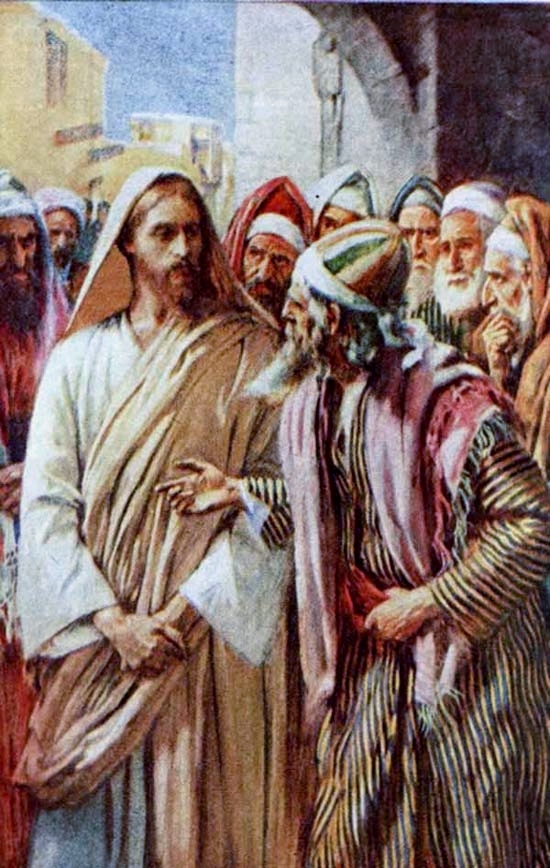
Related imageIn the Gospel the Pharisees, who never loved Jesus came again to question Him. “Princes plot together against God and His anointed...He who is enthroned in the heavens laughs, God is making a mockery of them” (Ps 2:2-4). One of them asked, “Teacher, which is the greatest commandment of the law?” Jesus answered them kindly, and even more. He summarized the law and taught a new lesson with a new horizon of understanding for all ages. 

You shall love the Lord your God with all your heart, and with all your soul, and with all your mind. “This is the greatest and first commandment.” This is our call; it is the reason why God created us. We cannot put anything between our relationship with God. Loving God must be the first response of our heart in love. We must recognize in our hearts that undivided and unequal impulse of love towards God. God is the source of love, and must be loved first if we ever want to love at all. 

2.0.  The Transfer of Love
You shall love your neighbour as yourself. This is where we encounter difficulty. And that was one of the reasons for the laws in the first reading, to overcome the obstacles in loving our neighbour. Jesus opens up this new horizon where we come to understand that love of God is not separated from love of neighbour. “Anyone who says, ‘I love God’ and hates his brother is a liar...” (1 Jn 4:20-21). However, loving the other as ourselves is not the projection of our weak selves to others. It does not imply the transfer of our subjective disposition, such that we tend to reduce people to ourselves. It is relating to others with that self that has been consumed by love of God. And since God is the source of love, our love for our neighbour brings something of God to them. Through our words and actions, God’s love is transferred to others. 

We can now love one another genuinely, no matter who they are or where they are from, because the love of God has been poured into our hearts (cf. Rm 5:5). This out pouring of God’s love in the Holy Spirit has become a new law written, not on tablet of stones, but in our hearts (cf. 2 Cor 3:3. Heb 10:16). And the ultimate gift of His love that God has given us is Jesus Christ. “For God so loved the world that He gave His only Son..”(Jn 3:16). 

3.0. The First Neighbour
Jesus is God and Man. In Him God has visited His people (cf. Lk 7:16). He is that living point of encounter between love of God and neighbour. And He unites the two and makes it possible for us to possess them as one. As the First Born of all creation, Jesus is our first Neighbour! Though in Him dwells the fullness of divinity, still He loves us with a human heart. It is Him who engineers this love in us. Therefore, to love our neighbour as ourselves begins with Jesus. It is through Him that our human love encounters God. At that point of encounter where our human heart grabs the person of Jesus as neighbour, is when we begin to the journey to love our neighbour as commanded. “You must love one another just as I have loved you” (Jn 13:34). 

“Anyone who has seen me has seen the Father” (Jn 14:9). In Jesus the Unseen God has revealed Himself. Our undivided love in Christ Jesus consumes all our heart, soul and mind. And this renews us, making us to assume the image of Jesus. The Love of Christ overwhelms us...that we live no longer for ourselves, but for him who dies and was raised to life for us (cf. 2 Cor 5:14-15). So we love others with that self which has been redeemed by Christ. Hence, the first and perfect Neighbour we love is Jesus. In this way we can love people even in the midst of their shortfalls. Since we have the one perfect Neighbour, we can endure the imperfections of others. 

4.0.  The Love Encounter
On these two commandments depend all the law and the prophets. All the blessings of the law and the promises of prophecy now find their completeness in Christ Jesus our Lord (cf. Mt 5:17). Accepting Jesus as our First Neighbour, in whom and through whom we Love God and neighbour, becomes an encounter of blessings. Here is offered an assurance of all prophetic future.

Love conquers all. Loving God and neighbour in and through Jesus Christ is our victory over every obstacle to love and observance of the law. Such love that is first touched by Christ cannot be mere emotional. Encountering each other in love has become a living expression of our ultimate encounter in Jesus. Therefore, we love each other basically because of Jesus Christ. 

Such loving encounter amongst us is a living response, and it is life-giving. It brings freedom and refreshes our lives.        
Happy Sunday!
_____________________________________
Fr Jude Chinwenwa Nwachukwu, C.Ss.R
St Paul’s Catholic Church,
Gwagwalada, Abuja
Nigeria.
October 29, 2017.

Tuesday, October 24, 2017

THE COIN OF HOMAGE


Reflection for 29th Sunday of in ordinary Time A
(Is 45:1, 4-5, 1Thes 1:1-5, Mt 22:15-21)
Related image
1.0.The Trap
“Set a guard, O LORD, over my mouth; Keep watch over the door of my lips” (Ps 141:3). Speech can be deceptive, as it can be the gateway to express wisdom and truth. Whoever that does not err in what he says is an upright and righteous person. It is from the abundance of the heart that the mouth speaks (cf. Mt 12:34). So a guard over the mouth begins from the heart, and a slip of tongue is a betrayal of the heart. The tongue can be a trap. Many people have entered trouble due to what they said causally or otherwise. Some relationships and families are caught up in the trap of unforgiveness due to what was said or heard. And they set this trap for Jesus.

“The Pharisees went and took counsel how to entangle Jesus in his talk.” They planned it so well that they did not approach him themselves. They remained anonymous but forwarded their servants and the Herodians. The Pharisees were against paying tax to the Roman authorities while the Herodians supported it. But they have a common interest: both did not accept Jesus. 

Their sugar-coated tongue was to trap Jesus so that they could unleash their malice on Him. “Teacher, we know that you are true, and teach the way of God truthfully, and care for no man; for you do not regard the position of men.” How often do we fall for sweet speech! We readily feel happy when people tell us what we want to hear or boost our ego. In such a situation, the trap can easily catch us. Only the truth can set us free (Jn 8:32). And if our hearts are set on Jesus, the way, the Truth and the Life, the snare shall be broken and we will escape (cf. Ps 124:7).

2.0. Caesar’s Coin
“Render therefore to Caesar the things that are Caesar’s...” Secular authority is good in itself for ordering society. But whenever secular authority is raised as a standard for determining allegiance to the Divine, malice germinates. All authority belongs to God. Isaiah explains this in the first reading, where God chose Cyrus, a pagan king, to achieve His will. “I am the Lord, and there is no other.” So both Caesar and his coin must serve to achieve God’s purpose, and respect human dignity. At the end, what belongs to Caesar gives way for what belongs to God.  
  
3.0. The Coin of Homage
Jesus has become the transforming link through which we understand that there should not be contradiction between the secular and the sacred. Such division can only exist as the product of malice. Caesar’s coin with its imprint is now symbolic. It has helped us trace God’s own coin and His imprint on it. God’s image and likeness is imprinted in the human heart. So, in giving back to God what belongs to Him, we must return the human heart to its creator. Thus, the heart is now our coin of homage given back to God, as the one to whom our homage is due (Ps 61:1). 

But this imprint of the likeness of God in human heart can be blurred by sin or covered with malice. In this case we may not be able to give God what is His due, or we may over stretch the relevance of Caesar’s coin. What is the way out? Thanks be to our Lord Jesus Christ, who came to dwell among us as the First Born of all creation (Col 1:15b), and in Him is the fullness of Divinity (Col 1:19; 2:9). He carries that perfect image of the Unseen God (Col 1:15a) which cannot be diminished. “And in Him you too find your own fulfillment, in the one who is the head of every sovereignty and ruling force” (Col 2:10). Now, a renewed imprint is enshrined in our hearts through baptism. Thus, Christ Jesus redeems our coin of homage—our hearts—such that only through Him can we offer fitting homage to God. In so doing, the perfect gift which belongs to God, and which we offer back to Him, is Jesus!

4.0. Paying due Homage to God
“...And to God the things that are God’s.” We cannot give anything less. Jesus has made the highest offering, and gave Himself to be offered as the most perfect gift. This living offering is re-enacted at every Eucharistic celebration. The Eucharist shines out as our living Coin of homage, in which we render back to God what perfectly belong to Him, and our due homage. From there we draw strength to fulfil our civic responsibilities, without denying God what belong to Him. 

Also, the Eucharist trains us in silence and gathers our hearts to Jesus such that the words of our mouths and the meditations of our hearts will be acceptable to the Lord (cf. Ps 19:14). And it pushes us forward in charity to be considerate, and recognize others even in our prayers as St Paul did to the Thessalonians in the second reading. This interpersonal dimension creates the platform through which we bring to action our participation in the perfect offering of Jesus to the Father. 

Therefore, the Coin of the Eucharist, nourishes the imprint of Jesus in our hearts. We are no more worried about Caesar’s coin. Our full homage has been taken over through the Eucharist.
___________________________________
Fr. Jude Chinwenwa Nwachukwu, C.Ss.R
St Paul’s Catholic Church,
Gwagwalada, Abuja.
Nigeria.
22/10/2017
Mission Sunday.

Friday, October 20, 2017

THE ROYAL BANQUET


Reflection for the 28th Sunday in Ordinary Time Year A
(Is 25:6-10, Phil 4:12-14.19-20, Mt 22:1-14)
1.0.  “On this Mountain...”
Today the Prophet Isaiah declares the mountain of salvation. On this mountain, the Lord of hosts will prepare for all peoples an expensive feast. And there he would remove the veil spread over all nations. This mountain of celebration is also a platform of salvation, where death would be destroyed forever, tears wiped away from all faces, and the reproach of God’s people removed. This is a living mountain where all who come live freely and happy. It is a mountain of grace. “Let us, then, have no fear in approaching the throne of grace to receive mercy and to find grace when we are in need of help” (Heb 4:16). Isaiah’s prophecy was fulfilled on Mount Calvary and is celebrated today in the Eucharist.
 
2.0. “ ...Come to the marriage feast”
Jesus tells us the parable of the King who organized an expensive wedding for his son. The king loved his son so much that he committed so much to celebrate him. And he extended this love and joy to others, inviting them to participate in the love he has for his son. “But they would not come.” Imagine such embarrassment! Still he was patient and kind enough to send more servants, this time with deeper explanation about the splendour of the party. “But they made light of it and went off, one to his farm, another to his business, while the rest seized his servants, treated them shamefully, and killed them.” How can they be causal to what their king takes seriously? They brought destruction upon themselves...But the king would not allow his son to hang in shame. New guests were invited, this time peoples from every corner of the earth, both bad and good. And the hall was full.

So the parable tells about the wedding feast of the lamb (cf. Rev 19:6-9). It talks about the transfer of the invitation to the Gentiles, and the marriage of Jesus and the Church—a permanent union, where Jesus is the Head and the Church His Body (cf. Col 1:18). The gathering of the Church is a foretaste of the eternal gathering of the children of God in Heaven. And the Church celebrates Jesus. So Jesus is that living Mountain of salvation, where are drawn to feast and to be saved.

3.0.  The Wedding Garment
“When the king came in to look at the guests, he saw there a man who had no wedding garment.” The wedding garment ordinarily belonged to the Bridegroom and Bride. Now the invited guests are expected to put on the same garment. We have to put on the resemblance of Christ, such that God the Father sees the image of His Son in us. Hence, we are grafted into the wedding feast as His adopted sons and daughters. By choosing us to share in the love the Father has the Son, we have become a royal people, chosen for His own possession (1 Pet 2:9). 

Thus, wearing the garment means putting on the image of Christ and the Church—the Bridegroom and the Bride. Though we are sinners and unworthy of so great a Banquet, we must purify our selves, receive His forgiveness and imitate Jesus in our daily lives. The Holy Eucharist nourishes us. We consume Jesus, and must reflect his righteousness in our lives like a garment. Our actions should showcase what we profess—indicating we have accepted the invitation to dine at the Royal Banquet. But the one who fails to put on the wedding garment—who approach this Banquet unprepared—would be treated like the first invitees who turned against the King (1 Cor 11:28-32).

4.0.  “For many are called, but few are chosen”
Jesus warns us: to receive the invitation is not an end in itself. It is not enough for one to be a member of the Church or a pious group. Those who have received the grace to share in the love of the Father in the Son must back it up with an active live of virtue. Desire for heaven is not sufficient, our garment, our daily lives must reflect the righteousness of Jesus and faith of the Church. St Paul gives us a practical step to achieve this in the second reading.

“...In any and all circumstances I have learned the secret of facing plenty and hunger, abundance and want.” He gives us example of a certain level of detachment from material things, such that our motivation is not determined by what we have or do not have. In this way, whether we have farm or business, we always long to climb the Mountain of salvation. This disposition of detachment would enable us realize that it is God who supplies our every need according to His riches in glory in Christ Jesus (Phil 4:12.19).  

The external manifestation of this disposition constitutes a response to the Banquet on this Mountain of grace. And the habitual living out of this disposition of detachment for the Royal feast becomes a garment in which we resemble the Bridegroom and the Bride. These are the chosen few. And they will always be few. Our determination is to ensure we are among this chosen few.

Fr Jude Chinwenwa Nwachukwu, C.Ss.R
Sacred Heart Catholic Church,
Gwagwalada, Abuja.
Nigeria.
October 15, 2017.


Tuesday, October 10, 2017

A DAY’S WALK


Reflection for Tuesday of 27th Week in Ordinary Time Year A
(Jonah 3:1-10, Lk 11:1-4)
1.0. The Second Call
The word of the Lord came to Jonah the second time…He tried to escape the first time but ended in the belly of a big fish. He prayed, God heard him and rescued him. At this second call, he dare not try anything funny. I guess fear of the first ordeal wasenough to fly Jonah to Nineveh, if love of preaching would not move him. “So Jonah arose and went to Nineveh, according to the word of the Lord.”
Related imageUnlike other prophets, Jonah did not have much to say to the Ninevites. His preaching sounded monotonous. Yet forty days, and Nineveh shall be overthrown!” There was no elabourations, no demonstrations or stories to convince his audience. It is obvious that Jonah did not go for love of the people, but just to please God and probably to avoid being swallowed by something else…

Nineveh was a city beyond compare; a great city with great sinners. The size of the city is described as taking three days journey in breath. Surprisingly, the Prophet only made a day’s journey and the whole city repented. Then we begin to wonder whether God actually needed Jonah to convert the city. His effort became insignificant in the face of the magnitude of the outcome. 

2.0. A Day’s Walk
Jonah’s one day journey was necessary for God to renew the city. “I did the panting, Apollos did the watering, but God gave growth” (1 Cor 3:6). God requires our availability. The efforts we make to bring the Gospel message and it’s righteousness to those around us are like Jonah’s one day walk into Nineveh. It is God who brings the efforts to completion. So the preacher or the one who shows good example, must do it with utmost humility, relying solely on God. It is not for show or to impress. Such a one ought to be like Mary at the feet of Jesus, as we read in the Gospel today.  

The journey is long; we may not see the end of it. We have a lot to fret and care for like Martha. But a day’s walk at the feet of Jesus accomplishes much. Jonah’s words were few. But at the feet of Jesus words may disappear. The sound of silence communicates the trust and represents the humility. Therefore, a day’s walk with Jesus ought to be our disposition in facing life challenges and in responding to God’s call.


Fr Jude Nwachukwu, C.Ss.R
Mater Domini Community,
Enugu, Nigeria.
October 10, 2017.